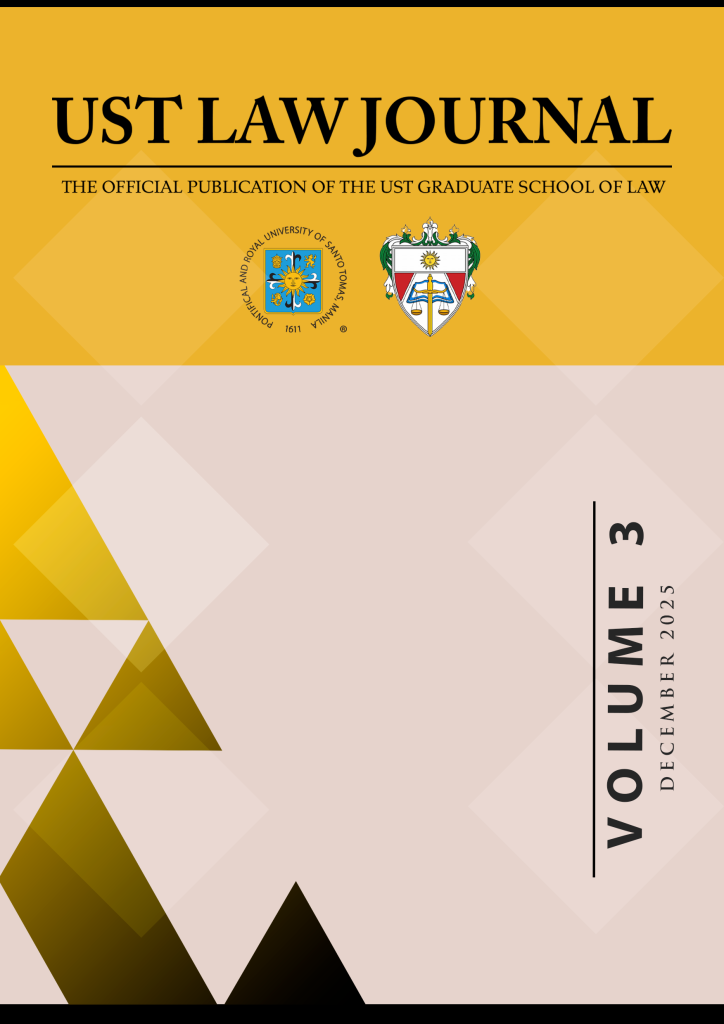
VOLUME 3
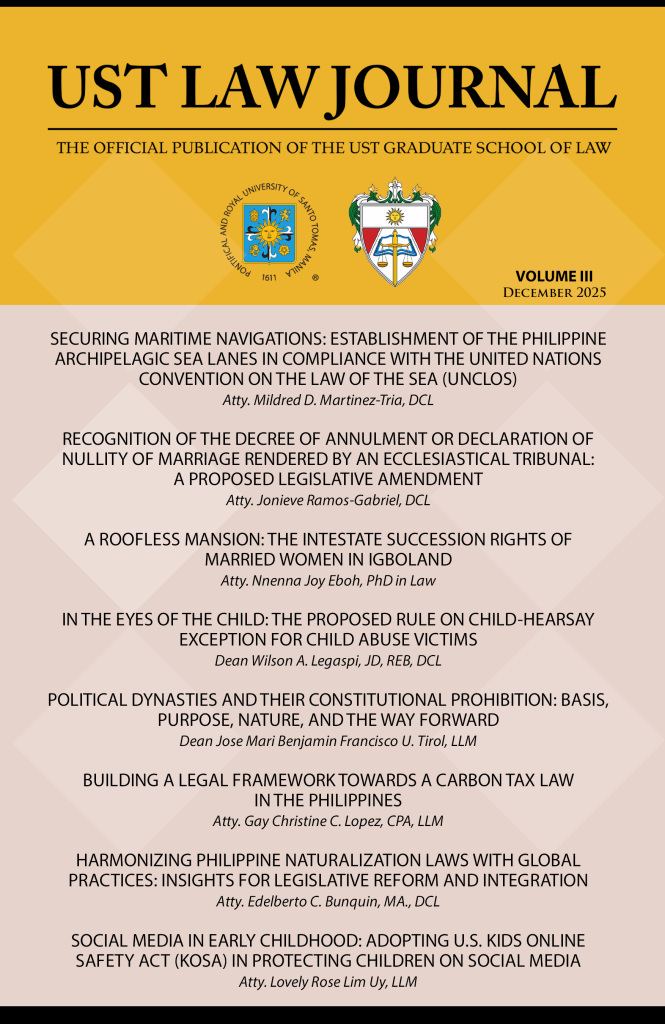
SECURING MARITIME NAVIGATIONS: ESTABLISHMENT OF THE PHILIPPINE ARCHIPELAGIC SEA LANES IN COMPLIANCE WITH THE UNITED NATIONS CONVENTION ON THE LAW OF THE SEA (UNCLOS)
Atty. Mildred D. Martinez-Tria, DCL
RECOGNITION OF THE DECREE OF ANNULMENT OR DECLARATION OF NULLITY OF MARRIAGE RENDERED BY AN ECCLESIASTICAL TRIBUNAL: A PROPOSED LEGISLATIVE AMENDMENT
Atty. Jonieve Ramos-Gabriel, DCL
IN THE EYES OF THE CHILD: THE PROPOSED RULE ON CHILD-HEARSAY EXCEPTION FOR CHILD ABUSE VICTIMS
Dean Wilson A. Legaspi, JD, REB, DCL
POLITICAL DYNASTIES AND THEIR CONSTITUTIONAL PROHIBITION: BASIS, PURPOSE, NATURE, AND THE WAY FORWARD
Dean Jose Mari Benjamin Francisco U. Tirol, LLM
BUILDING A LEGAL FRAMEWORK TOWARDS A CARBON TAX LAW IN THE PHILIPPINES
Atty. Gay Christine C. Lopez, CPA, LLM
HARMONIZING PHILIPPINE NATURALIZATION LAWS WITH GLOBAL PRACTICES: INSIGHTS FOR LEGISLATIVE REFORM AND INTEGRATION
Atty. Edelberto C. Bunquin, MA., DCL
SOCIAL MEDIA IN EARLY CHILDHOOD: ADOPTING U.S. KIDS ONLINE SAFETY ACT (KOSA) IN PROTECTING CHILDREN ON SOCIAL MEDIA
Atty. Lovely Rose Lim Uy, LLM
I am honored to welcome the readers of the third volume of the UST Law Journal, the official publication of the University of Santo Tomas Graduate School of Law.
The ULJ serves not only as a platform for publication for our academic staff, students, alumni, and other legal scholars, but also as a testament to our commitment to intellectual discourse in law and to advancing legal scholarship in the service of justice and truth — iustitia et veritas.
With the global innovations and intersection of human relationships and transactions, the role of legal scholarship has never been more important. One must continually analyze the current legal conditions and propose amendments and upgrades to ensure the law remains relevant. Laws must never be stagnant; they should be ever-evolving and changing to serve the needs of humans for the common good. The study of law should also never be just for academic purposes, but must be a living instrument for nation-building.
I commend the authors—students, alumni, and scholars—whose works exemplify disciplined research, critical thinking, and a deep understanding of the law in an increasingly globalized context. Your contributions affirm the capacity of our Thomasian legal scholars to shape discourse and influence policy through thoughtful and well-reasoned analysis.
I also extend my sincere appreciation to the Editorial Board, whose tireless dedication has made this volume a reality. Your efforts ensure that the UST Graduate School of Law Journal remains a trusted platform for legal discourse and excellence.
May this third volume inspire further legal scholarship. Congratulations on this significant achievement. May the journal continue to thrive for years to come.
Jacqueline O. Lopez-Kaw, DCL
Dean, UST Graduate School of Law
It is with profound joy that I convey this message for the third edition of the UST Law Journal. As a peer-reviewed scholarly publication, it attests to UST Graduate School of Law’s unwavering commitment to rigorous research, deep insights, and critical engagement in the legal field.
The articles presented herein demonstrate a meticulous yet well-rounded approach to legal research. They characterize a clear, consistent, and thorough analysis of the matter. They reflect the collaborative efforts of our faculty and students as they make meaningful contributions to the advancement of concurrent discourses, addressing topics that span the legal landscape with a proper constitutional foundation and jurisprudential discipline.
The UST Graduate School of Law remains steadfast in its relentless pursuit of truth through research studies, as rooted in Thomistic scholarly heritage. This pursuit is embodied in the UST Law Journal through its intellectually demanding yet morally grounded studies, which are attuned to the needs of society. I trust that the research contributions in the manuscript will contribute to further discussions in the legal academe and policy-making bodies, thus emboldening future studies that move towards a more rational, ethical, and committed legal order.
My heartfelt acknowledgment to the board of editors, peer reviewers, and contributors who shared their passion in ensuring the scholarly integrity of this edition.
May this edition of the UST Law Journal serve as a significant contribution to the Philippine legal literature and a lasting testament owing to the relevance of the wisdom of St. Thomas Aquinas in the search for truth.
Rev. Fr. Dexter A. Austria, O.P., SThD
Regent
It is with great pride that we present the Third Volume, Issue No. 3 of The UST Law Journal, a collection of timely, thought-provoking, and forward-looking scholarship that reflects the dynamic and evolving landscape of law in the Philippines and beyond. This volume brings together diverse yet interconnected areas of legal inquiry from the depths of maritime governance and climate policy to family law, political reform, citizenship, and the rights of vulnerable sectors. Each article contributes to the ongoing national and global conversations about justice, development, and human dignity.
This 3rd Volume opens with critical discussions on the Philippine Archipelagic Sea Lanes, examining how international law and domestic legislation intersect to shape maritime security, navigational rights, and the assertion of archipelagic sovereignty. Paired with this is a forward-looking analysis of naturalization and citizenship, exploring how Philippine laws can harmonize with global practices to embrace mobility, migration, and modern notions of national integration. Environmental governance also takes center stage, with a rigorous study on establishing a carbon tax framework in the Philippines. This work confronts the legal, economic, and institutional challenges of climate change, offering insights that move us closer to a sustainable and resilient future.
This year’s edition likewise amplifies the voices of marginalized and vulnerable groups. The article on women’s intestate succession rights in Igboland underscores the universal struggle for gender justice across cultures and legal systems. Meanwhile, the discussion on social media exposure in early childhood raises pressing concerns on privacy, safety, and regulation in a rapidly digitalizing world.
Our contributors also examine foundational issues of governance and family relations. The article on political dynasties and their constitutional regulation revisits an enduring democratic challenge, shedding light on the path toward greater political equity and institutional reform. Complementing this is a carefully reasoned work on annulment and ecclesiastical tribunal decrees, which confronts the complexities of harmonizing religious practices with constitutional and civil law principles.
Taken together, these articles reflect the journal’s commitment to fostering rigorous scholarship, encouraging interdisciplinary dialogue, and confronting the pressing legal questions of our time. The Third Volume stands not merely as a compilation of research, but as an invitation to rethink, question, and build a more just, informed, and responsive legal order.
The Editorial Board extends its gratitude to our authors, reviewers, and readers for this 3rd edition. May this volume continue to inspire meaningful engagement within the legal community and contribute to the growing body of scholarship shaping the nation’s future.
Irene D. Valones, DCL, DPA
Editor-in-Chief
© Copyright 2024. UST Law Journal. All Rights reserved.